German Pretzel
Trying my hand at the authentic German Pretzel
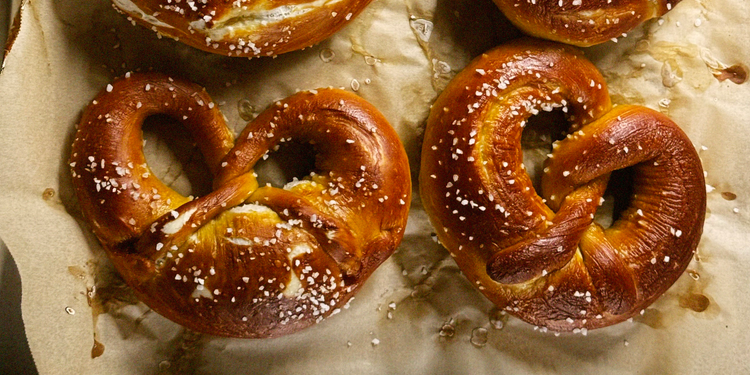
Dense, golden, lye-dipped pretzels with a crackling crust and chewy bread-flour center.
Growing up, the benchmark for me was a pretzel from a small bakery called German John's, one town over in Hillsboro, New Hampshire. No pretzel came close - until a trip to southern Germany and time spent in Munich. Even then, nostalgia rules: my true preference is for a day-old German John's pretzel pulled from the ruins of a crumpled paper bag, slathered in mustard and wolfed down before soccer practice. A formative memory, and one my family has been chasing ever since moving out to Colorado - where even at places serving very good German food, the pretzels are never lye-dipped, nudging them closer to the ubiquitous mall pretzel than the genuine article.
After years of complaining, I decided to just make them myself - spurred on by watching Claire Saffitz make lye dipping seem far less frightening than I'd assumed. Two batches in, they've turned out great. I am not a baker. I plan to keep perfecting these.
Ingredients Makes 6 large pretzels.
- 3 cups (360g) bread flour
- 1 cup (240ml) warm water
- 1 tablespoon (12g) brown sugar
- 1 teaspoon (3g) instant yeast
- 1½ teaspoons (9g) kosher salt, plus coarse pretzel salt for topping
- 2 tablespoons (28g) unsalted butter, softened
- 1 tablespoon (8g) Bakers Club Artisan Diastatic Malt Powder
- Lye bath: 3 teaspoons (15g) food-safe lye dissolved into 4 cups (950ml) cold water
Directions
The dough benefits from a cold overnight rest in the refrigerator - strongly recommended over baking the same day, but I've done the whole thing in two and a half hours so you do you. The flavor deepens considerably overnight and the dough becomes much easier to shape when cold and firm. This is what helps achieve the most important thing - the thin, very crispy and crunchy ends of the arms where they connect back to the belly of the pretzel.
- Combine warm water, yeast, and brown sugar. Let bloom for 5-10 minutes until foamy.
- Add bread flour, malt powder, and salt to the yeast mixture. Mix until a shaggy dough forms, then add softened butter and knead until smooth and elastic - about 8-10 minutes by hand or 5-6 minutes with a stand mixer using the dough hook.
- Form into a ball, place in a lightly oiled bowl, cover, and refrigerate overnight - or let rise at room temperature until doubled, about 1½ to 2 hours.
- Divide the dough into 6 equal portions (roughly 170g each). Shape each into a smooth ball and refrigerate uncovered on a baking sheet for at least 30 minutes before shaping.
- To shape: roll each ball into a long rope, around 24 inches, thicker in the center and tapering toward the ends. Cross the ends, twist once, then fold back down onto the thick center and press gently to seal. Return to the baking sheet and let rest 20 minutes.
- Prepare your lye bath wearing gloves and eye protection. Dissolve lye slowly into cold water - never the reverse. The solution will heat up on its own. Let it cool before using.
- Dip each pretzel in the lye solution for 20-30 seconds, remove with two hands like you're cradling a baby bird so the pretzel doesn't lose its shape, and place on a parchment-lined baking sheet. Score the thick center section with a sharp knife or lame at a shallow angle.
- Sprinkle generously with coarse pretzel salt. Pro move: finish with a pinch of Smoked Maldon Sea Salt.
- Bake at 475°F for approximately 10-15 minutes, until deeply mahogany brown. The color is the goal - don't pull them early.
- Serve with Alstertor Dusseldorf Style Mustard - the one that comes in the mini beer can. Leftovers go in a paper bag on the counter for that real, next-day-before-soccer-practice experience 24 hours later.
Tips
- Bread flour is non-negotiable for the dense, chewy center that separates a real Bavarian pretzel from everything else.
- The lye bath is what produces the dark crust and distinctive flavor. Food-safe lye is available online. Do not substitute baked baking soda - it works but the result is noticeably different.
- Coarse pretzel salt should be applied immediately after the lye dip, before baking.
- A day-old pretzel eaten cold, torn apart, with good mustard is arguably the peak experience.
Member discussion